 User Documentation
 A menu module can be both used to display a horizontal menu (usually on top of the page) and a vertical menu (usually in a sidebar, left or right). In a horizontal (top) menu it is not desirable to keep the submenu open. That's why the default behaviour of a menu module is to close the submenus on page load.
Toggle status "open" behavior
However, in a vertical (sidebar) menu, it is often desirable to leave a submenu open when it contains the active menu item. In Joomla 6.0 a new CSS class nav-active-open was introduced specifically to allow control over whether submenus are automatically opened on page load for the active menu item. Setting this class now makes it possible to achieve this. The class can be conveniently set in the module via the backend.
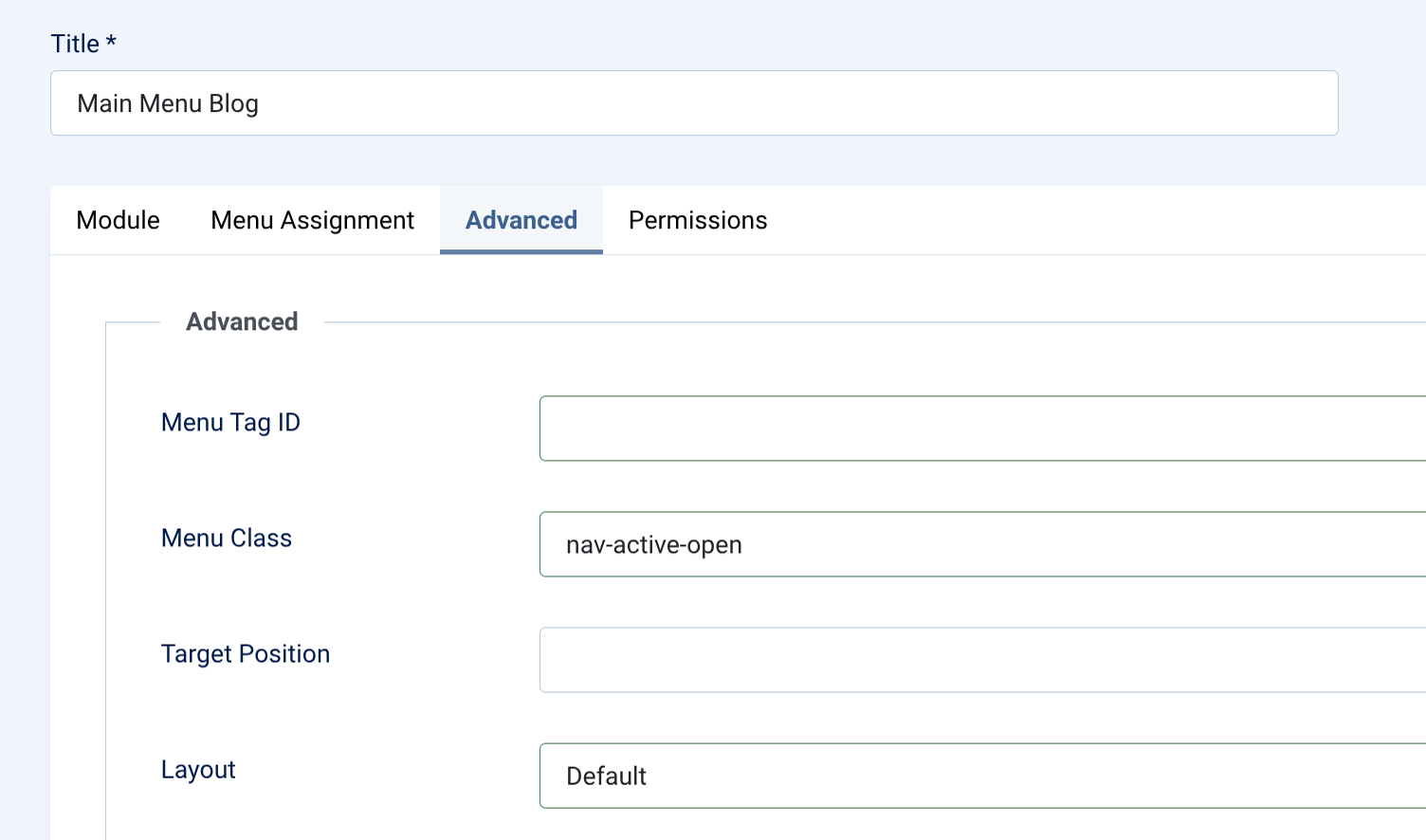
How to make a sidebar menu without dropdown toggle
If you want to keep all submenus open, you don't need a dropdown toggle. In order to accomplish that you have to make a so called template override. See the article about template overrides.
This is how this particular template override is done:
- Start by selecting System → Templates → Site Templates in the Administrator menu and then select the Cassiopeia Details and Files item. That will open the Templates: Customise (Cassiopeia) form.
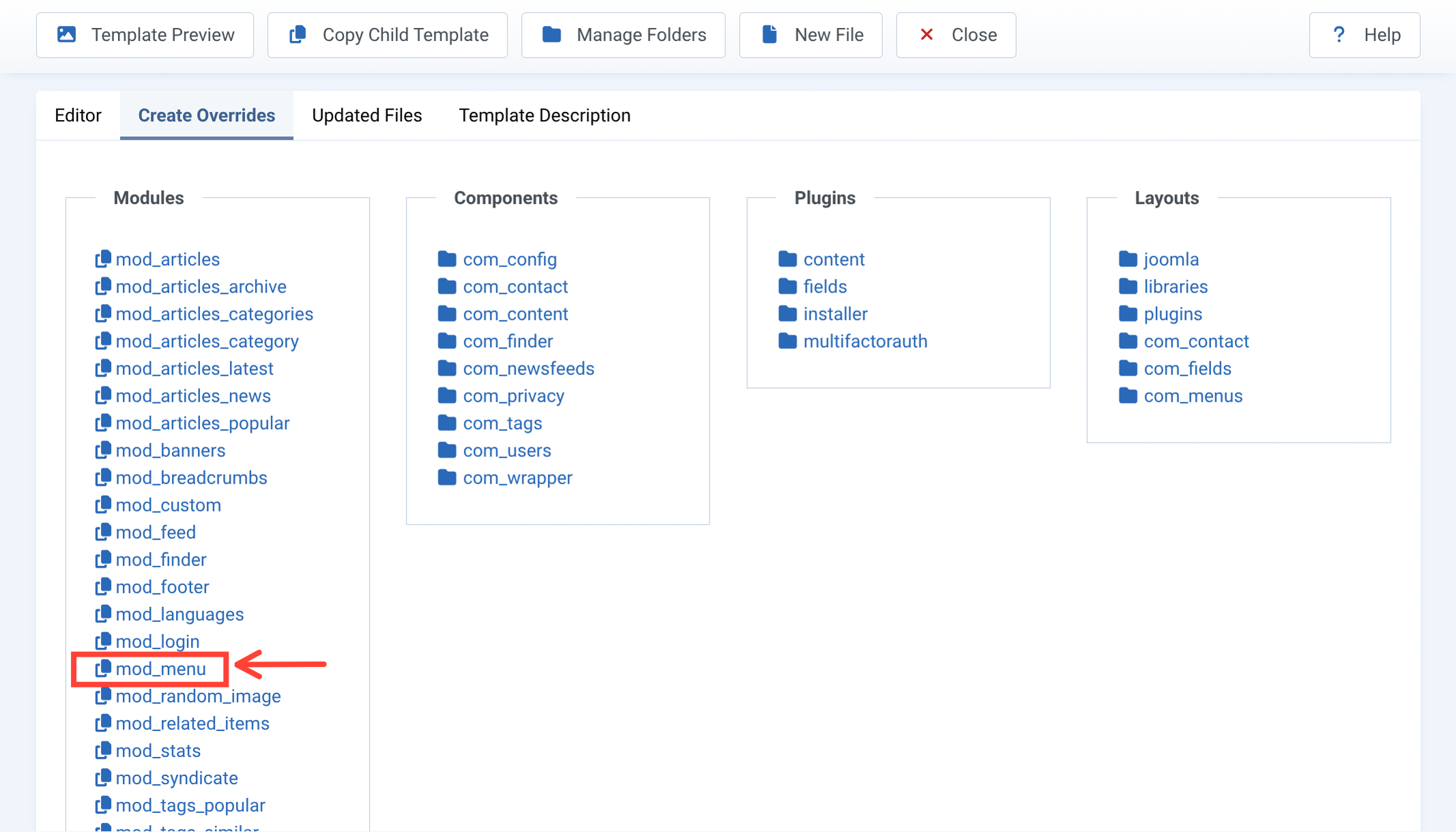
- Switch to tab Create Overrides and and select by clicking mod_menu
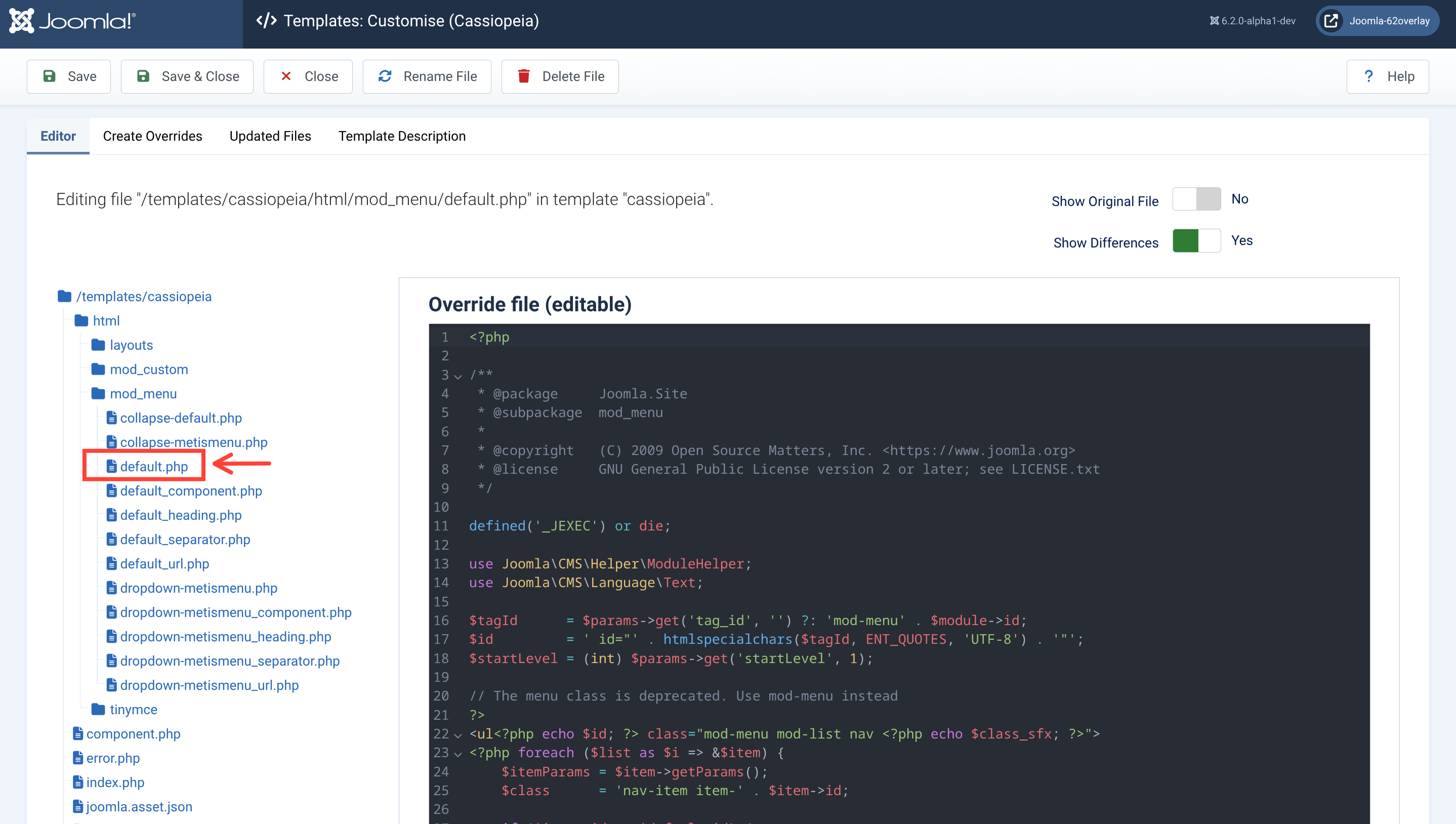
- Go back to the editor tab and expand the entries under HTML → mod_menu. Here you will find the entry default.php. Open the file and start editing your override.
- To display the menu as a plain list - without the toggle function and without the associated accessibility buttons - we need to remove the code lines listed here.
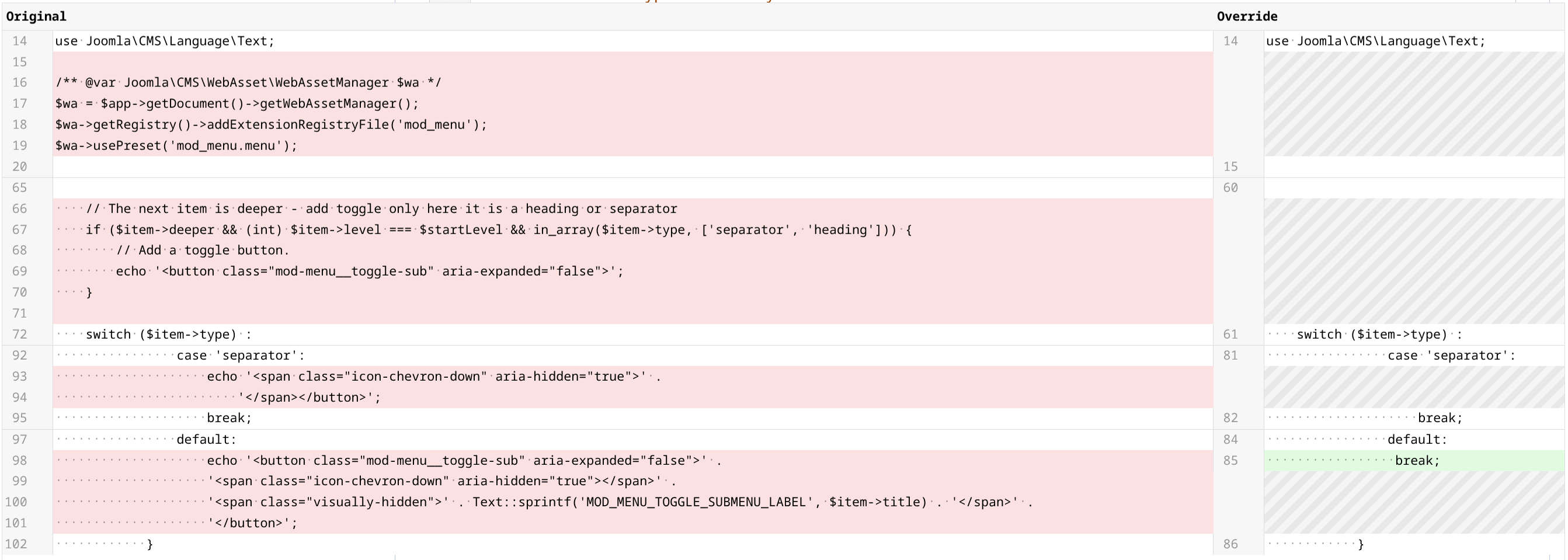
Remove lines 15 - 20
/** @var Joomla\CMS\WebAsset\WebAssetManager $wa */
$wa = $app->getDocument()->getWebAssetManager();
$wa->getRegistry()->addExtensionRegistryFile('mod_menu');
$wa->usePreset('mod_menu.menu');
Remove lines 66-71
    // The next item is deeper - add toggle only here it is a heading or separator
    if ($item->deeper && (int) $item->level === $startLevel && in_array($item->type, ['separator', 'heading'])) {
        // Add a toggle button.
        echo '<button class="mod-menu__toggle-sub" aria-expanded="false">';
    }
Remove lines 93 - 94
                    echo '<span class="icon-chevron-down" aria-hidden="true">' .
                        '</span></button>';
Replace lines 98 - 101 with `break`
                    echo '<button class="mod-menu__toggle-sub" aria-expanded="false">' .
                 break;
                    '<span class="icon-chevron-down" aria-hidden="true"></span>' .
                    '<span class="visually-hidden">' . Text::sprintf('MOD_MENU_TOGGLE_SUBMENU_LABEL', $item->title) . '</span>' .
                    '</button>';
Result
As a result, we get a plain list, without toggle functionality for our menu module.

Best Pratice Tip
Before you start creating overrides in your template, first create a child template. Do not edit the original template that comes with Joomla!, as this may be overwritten during the next update. The changes in your child template will be preserved.